

In this series, we've been working through a structured approach to making better decisions. We started with The Decision Intelligence Paradox, then explored why AI transformation fails when the outcome isn't clear in The Outcome Problem, and showed how to define one in The Outcome Solution. Most recently, in Defining Your Decision Space, we established the set of options — the meaningfully different paths available. With options defined, the next question is: how do you decide which ones matter most? That's where priorities come in — and where most organizations get stuck.
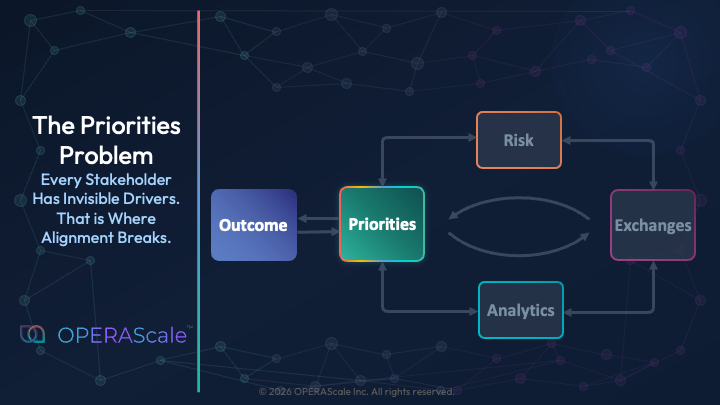
AI transformation is the initiative most organizations are racing toward — but declaring it a priority is not the same as transforming. It's an announcement. And the decision behind that announcement doesn't happen in a vacuum. Every stakeholder in that decision carries an invisible set of drivers — not just incentives and constraints, but values and principles that govern how they show up. The CEO optimizes for competitive positioning. The CFO optimizes for capital efficiency. The regional manager optimizes for crew retention and throughput. The front-line worker optimizes for dignity — in how the work gets done and how the change gets rolled out. Some of these drivers show up on a dashboard. Most don't.
None of them are wrong. But when those drivers are never surfaced, never compared, never brought into the same room — the transformation fractures along exactly those lines. The problem isn't just that organizations have too many priorities; it's that the driving forces behind each stakeholder's priorities are invisible — and invisible forces can't be balanced. That's why AI transformations stall. Not because the technology isn't ready, and not because people didn't care — but because the competing forces driving each stakeholder were never surfaced.
The Conventional Wisdom — and What It Misses
Recently, BCG published an article titled The Power of Priorities in a Transformation. The central message is clear: organizations attempting transformation must narrow their focus. Too many initiatives dilute energy, overwhelm teams, and stall momentum. Leaders must choose a small number of critical priorities, sequence them thoughtfully, and protect capacity.
They're right — as far as it goes. Most organizations fail because they try to do everything at once. But narrowing the list doesn't solve the deeper problem. You can cut your initiative count from 12 to 3 and still have every stakeholder in the room interpret those 3 differently. Choosing fewer initiatives is not the same thing as clarifying what you are optimizing for. And that distinction matters.
The Invisible Forces Behind Every Decision
When executives declare "AI transformation is our priority" or "Customer experience is our priority" or "Operational excellence is our priority" — they're announcing an initiative. But the real priority is the underlying driver that made that initiative win. Was it to prove competitive differentiation? Build measurable brand trust? Improve customer satisfaction scores? Establish a talent narrative? Most of the time, that reasoning has no place to live. It shapes the decision in the room, but there's no mechanism to carry it forward. The list gets communicated. The logic has nowhere to go.
And the gap runs in both directions. Every stakeholder in that organization also carries their own set of drivers — and not all of them are incentive-driven. A regional manager might be measured on throughput targets — but value team trust. A front-line worker's bonus might depend on transaction speed — but what they care about is dignity. The incentive and the value can pull in opposite directions for the same person, and neither is visible to the leader making the call. These forces don't appear on any dashboard. They're rarely surfaced in strategy conversations. But they shape how people interpret and respond to every initiative that gets handed down.
The issue isn't too many priorities — it's that the forces driving them, at every level, are invisible.
Invisible forces can't be balanced. You can't align around priorities you can't see. And you can't resolve resistance you don't understand.
We Already Do This — Individually
Every person already knows how to prioritize for themselves. In the book Your Brain at Work by Dr. David Rock, the author presents a simple example of the main character, Emily, who was recently promoted to an executive. She faces several competing tasks at the start of her day: hiring an assistant, writing an article, preparing for a conference, or catching up on email. Without realizing it, she's running a sophisticated prioritization process — filtering her choices through her own set of drivers, both practical and personal. He refers to it as looking for patterns. These patterns, evaluated through the OPERA framework lens, are inherently optimizing for five factors:
- Outcome - being successful in your role
- Priorities - gain efficiency, minimize time
- Exchanges - effort spent vs minimizing time
- Risk - leverage gained from hiring help
- Analytics - higher salary
She ultimately decides to review assistant applications after integrating all these factors. The process works because all the relevant context — her goals, her constraints, her incentives, and what kind of leader she wants to be — lives in her head. Since she is the only stakeholder, if her incentives, values or principles ever conflict, she can adjudicate them in her own head.
Now multiply her by every person in your organization. Each one is running the same process. Each one has their own set of drivers — incentives, values, principles. And almost none of it is visible to anyone else.
The Case for a Shared Decision Architecture
Meaningful transformation isn't about picking the right initiative. It's about creating a structure where competing priorities become visible — so people can reach a better solution together. Not "What are our top three initiatives?" but "What is each stakeholder actually optimizing for — and where do those forces conflict?" You cannot make tradeoffs you cannot see. You cannot balance forces you don't know exist — whether those forces are incentives, values, or principles. The decision maker doesn't need more data. They need a way to see the full map of what drives each stakeholder before a decision splinters.
Priorities are about optimizing the driving forces across each individual.
When those drivers are visible, alignment no longer depends on proximity to leadership. Tradeoffs become possible. Decisions become defensible. And the stakeholders who might otherwise pull in opposite directions can finally see where their priorities connect — and where they compete.
What Comes Next: Aligning Priorities Towards Outcome
The P in OPERA is designed to do one thing: surface what drives each stakeholder — and make those drivers visible to everyone in the room. An OPERA anchored priority isn't a task list or a ranked initiative. It's a structured declaration of what matters to a specific person, grounded in what drives them — incentives, values, and principles alike. Is it - Prove competitive differentiation? Improve labor efficiency? Increase order accuracy? Clarify role boundaries?
When each stakeholder articulates their priorities in a common format, the decision maker stops navigating blind and starts seeing.
In the next article, we show exactly how that works. Each stakeholder enters their priorities. Put them all in the same view, and something immediately becomes clear: some priorities align, while others compete. Cost and schedule compete in almost every business case — but other conflicts, including tensions between values and incentives, only become visible once the full map is on the table. That visibility is the starting point for tradeoff exploration. Once you can see where stakeholders compete, the debate has a structure. And once the debate has a structure, decisions stop fracturing.
We return to McDonald's and Wendy's — same stakeholders, same industry, opposite outcomes — to show what happens when priorities are visible versus invisible. McDonald's cancelled its own rollout. Wendy's is scaling to 500 locations. The difference isn't technology — it's whether the outcome was stated clearly enough for everyone to locate themselves inside it.
The lesson isn't about AI. It's about what happens when the reasoning behind a priority is visible versus invisible. Next, we show you what visible looks like.
About the Author