

Gartner just published its first Magic Quadrant for Decision Intelligence Platforms, a milestone for a field that Dr. Lorien Pratt, Nadine Malcolm, and Mark Zangari first defined back in 2008. After nearly two decades, the industry caught up.
While the report helps organizations evaluate AI-powered platforms, it sidesteps a more fundamental question: what if you can't AI your way to better decisions because the bottleneck isn't your platform, it's whether you have a framework for structuring the decision at all?
What the Gartner Magic Quadrant Gets Right
David Pidsley's recent article on decision intelligence capabilities nails a tension that anyone evaluating DI platforms will recognize: organizations want decision intelligence, but decision-centric user interfaces remain surprisingly rare. We agree with Gartner's diagnosis.
But here's the paradox it surfaces: Gartner requires platforms to support "explicit decision modeling," yet modeling a decision well requires a mental model first. You can't AI your way to better decisions if you haven't first figured out what decision you're making, what outcomes you care about, and what tradeoffs you're willing to accept. The model has to come first. The technology comes second.
Explicit Decision Modeling Is a Competitive Advantage
Pidsley argues that decision-centric thinking is becoming table stakes, and he's right. But there's a step before the technology that most organizations skip: building the decision structure. Explicit decision modeling isn't just about documenting what you decide; it's about surfacing the structure underneath.
- What are we committing to do together, and why?
- What priorities compete with each other?
- What tradeoffs are you actually willing to make?
Most organizations never answer these questions clearly. Instead, they collect data and run analyses. By themselves, AI-powered analytics are just a sophisticated rubber stamp, used to justify decisions, not to make better ones.
That's the gap explicit decision modeling closes, not by adding more AI, but by forcing clarity about what the decision actually is before any optimization begins.
Speed Comes From Alignment, Not Architecture
Pidsley is right that composite AI separates serious platforms from single-technique solutions. The ability to mix machine learning, simulation, optimization, and knowledge graphs is what makes modern decision intelligence platforms powerful. But speed doesn't come from technology alone. As Dr. Lorien Pratt, the creator of decision intelligence, puts it on a recent podcast: "Alignment is more important than your data. If your humans aren't aligned then your systems are unlikely to succeed."
Real speed comes from two places:
- Decision velocity, how fast you go from question to action
- Execution velocity, what happens after the decision is made
When teams share a clear shared picture of the decision and understand the trade-offs being made, you don't just decide faster, you execute faster. People aren't relitigating the decision in hallways or second-guessing the trade-offs. They're aligned.
These are human alignment problems, not algorithm problems. You can have an incredibly modular AI architecture, but if your organization hasn't done the cognitive scaffolding first, all that composability just helps you arrive at the wrong answer faster, then fumble the implementation.
Decision Frameworks Are the Missing Cognitive Scaffolding
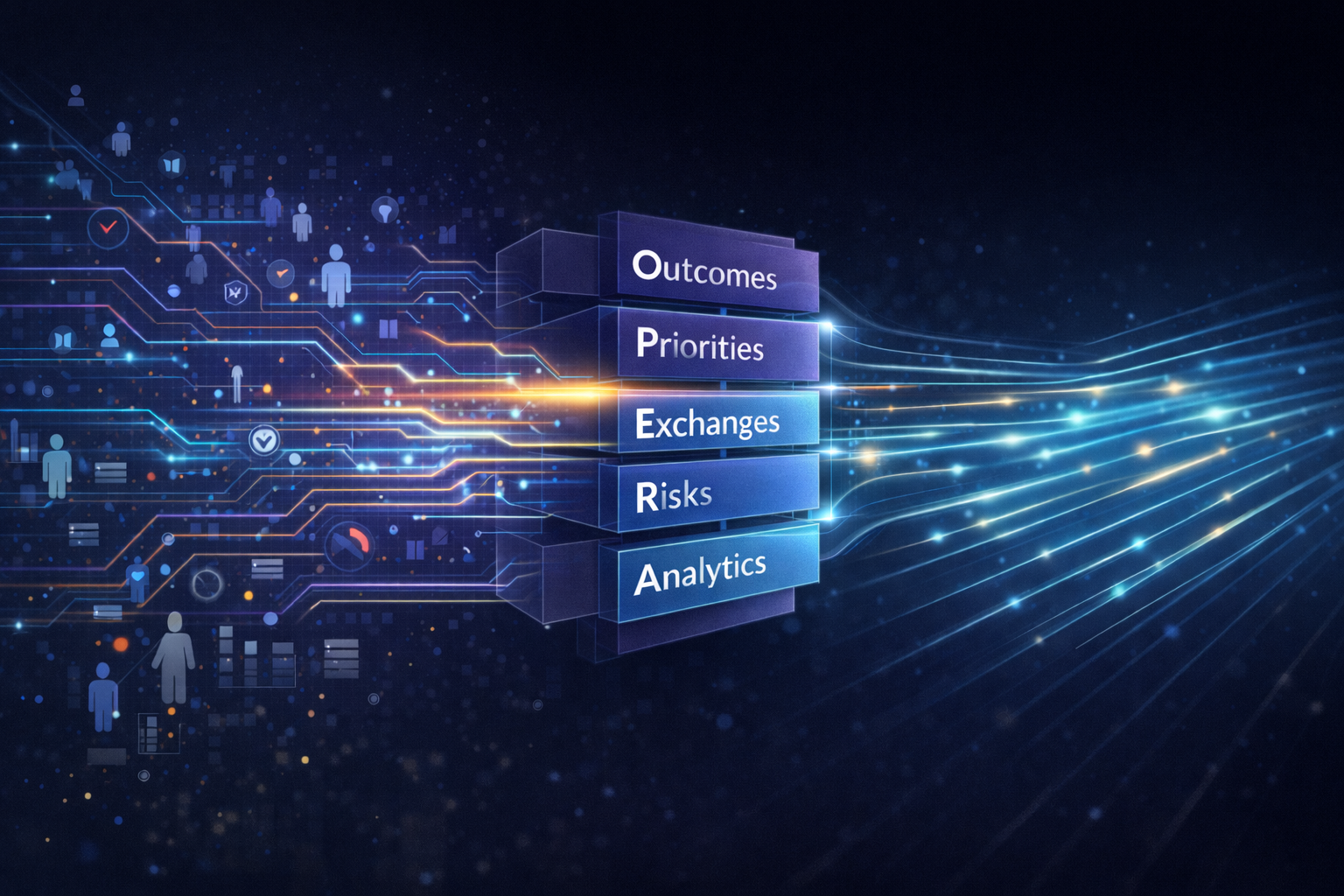
Decision frameworks build the mental model that decision intelligence platforms assume you already have. The O-P-E-R-A in OPERAScale™ - Outcomes, Priorities, Exchanges, Risks, and Analytics - is one such framework. Pratt and Malcom's Causal Decision Diagram (CDD), detailed in The Decision Intelligence Handbook, offer another approach. Both start in the same place: defining what you're actually trying to achieve and surfacing what matters most before any optimization begins.
Take a common scenario: engineering wants three more months to ship a quality product, but sales needs it before Q4. Without a framework, this devolves into a power struggle. With OPERA, you start differently.
- Outcomes: For example, deliver a certified integration to enterprise customers so that they can pass their compliance audits to minimize manual workarounds.
- Priorities: Is market timing more important than feature completeness?
- Exchanges: What are we willing to give up, a feature set, a revenue target, or a quality bar, to get what matters most?
This Priorities Exchanges debate is what our framework models first. Only after working through these questions do you bring in risk and analytics to pressure-test whether the tradeoff math actually works.
OPERAScale™ emerged from two decades of high profile decision-making work across Fortune 500 enterprises, government agencies, and startups. Our founder Laxmi Gandhi kept seeing the same pattern: organizations weren't struggling because they lacked data, they were struggling because they had no structured way to surface what actually mattered to the humans in the room.
Most platforms jump straight to analytics. OPERAScale™ makes you do the cognitive scaffolding first. Until you've made priorities and exchanges explicit, you're not making a decision, you're just running numbers. Both OPERAScale™ and the CDD approach address this gap, structured ways to build the mental model before asking AI to optimize it.
Framework First, Then Platform
The DI Handbook offers one path forward. OPERAScale™ offers another, focused specifically on human-centric decisions where subjective judgment matters as much as quantitative analysis. This isn't about replacing the platforms in Gartner's Magic Quadrant, it's about broadening what decision intelligence means to include the messy, human decisions that don't fit neatly into optimization models.
Decision intelligence doesn't fail because of bad algorithms. It fails because humans never agreed on what mattered.
About the Authors